From fishing nets to yoga pants: The legendary journey of Econyl regenerated nylon

The salty sea breeze and waves crash against abandoned fishing nets. Once a harvester of the deep sea, now a burden to the ocean. Months later, this abandoned net has been given a new life in a factory in northern Italy—transformed into a pair of flexible, skin-friendly, and sustainable yoga pants.
This isn’t science fiction; it’s Econyl’s reality. It revitalizes discarded plastics, allowing the fashion industry to quietly say “thank you” to the Earth while pursuing beauty.
Table of Contents
Abandoned fishing nets find a second life
Every year, approximately 640,000 tons of abandoned fishing nets are discarded in the world’s oceans. These “ghost nets” trap fish and entangle coral reefs. Econyl’s story begins with these “ghost nets.”
Italian engineering company Aquafil launched the Econyl project in 2011. Using chemical recycling technology, it breaks down discarded fishing nets, carpet fibers, and industrial plastics into virgin nylon molecules. This isn’t simply “recycling,” but rather a complete regeneration process. Through purification, polymerization, and reshaping, Econyl ultimately achieves the same quality as virgin nylon while reducing carbon emissions by up to 90%.
When this material is made into yoga pants, it feels light, has stable elasticity, and is even more breathable than traditional nylon. Behind each pair of pants is an ecological journey from the deep sea to the yoga mat—a story about responsibility, aesthetics, and technology.
The alchemy of waste to functional fibers
Traditional nylon production relies on oil, resulting in increased resource consumption and greenhouse gas emissions. Econyl’s core technology, however, is a closed-loop recycling system. This system completely breaks down discarded plastic materials back down to their molecular level before reassembling them. In other words, there’s no “waste destination,” only a “new beginning.”
Technically, this process is called depolymerization. Aquafil engineers use specific temperatures and pressures to reopen the nylon’s molecular structure, restoring it to its purest form. These molecules are then repolymerized into new fibers—those with the same elasticity and durability but with virtually no reliance on new raw materials.
For yoga pants manufacturers, this means a source of lighter, more stable, and more durable fabrics. Brands like Girlfriend Collective, Patagonia, and Adidas by Stella McCartney have all adopted Econyl to create collections that combine performance with environmental value. When consumers wear these pants, they not only experience freedom of movement but also participate in a global resource recycling revolution.
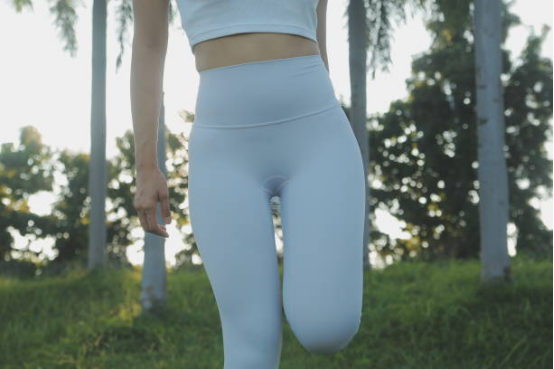
When aesthetics meets responsibility: Fashion’s green transformation
While sports equipment used to prioritize performance, today’s consumers are more concerned with their “ecological balance.” Especially in the yoga world, people are striving for physical and mental balance and are increasingly aware of how their choices can help the planet breathe more easily.
The use of Econyl in yoga pants represents more than just a technological innovation; it represents a shift in attitude. It shifts designers’ thinking from a “product lifecycle” to a “material lifecycle.” Instead of being scrapped, a pair of pants enters a closed-loop, recyclable system.
This philosophy is driving change across the fashion supply chain. According to a report by Textile Exchange, the number of brands using recycled nylon has tripled in the past five years. Meanwhile, consumer sentiment for sustainable consumption continues to rise, with over 70% of young people willing to pay a premium for products with lower carbon fiber content.
When you put on yoga pants made of Econyl, they not only fit your body but also, in another way, align with the values of our times. The sense of balance, lightness, and breathability they offer is a metaphor for sustainable fashion.
From factories to yoga mats: The temperature of the circular economy
Econyl’s journey doesn’t end when it leaves the factory. Aquafil has built a complete recycling ecosystem—when old yoga pants or carpets are discarded, they can re-enter the system to be recycled, broken down, and remade. This “circular production” transforms nylon from a disposable material into an infinitely recyclable resource.
For manufacturers, this means cost optimization and enhanced brand image; for users, it provides a more heartwarming consumer experience. More and more brands are launching “recycling and return programs,” inviting users to return their old clothes to the factory, allowing every piece of fabric to regain its meaning.
This is a new business logic: fashion is no longer about “buying more,” but about “making every choice more valuable.” As the life cycle of yoga pants can be redefined, the old model of fast fashion is also being gently reconstructed.

Poetry woven by technology: the story of future fabrics
The significance of Econyl goes beyond simply revitalizing fishing nets and imbuing the material with a soul. It has inspired more companies to consider: Can technology infuse fashion with a touch of poetry?
With the addition of 3D weaving technology and AI fiber optimization systems, future yoga pants may be able to adjust their support in real time based on the user’s movements; micro sensors will record movement postures; and recycled materials such as Econyl will become part of the underlying logic—providing a circular, intelligent, and sustainable infrastructure for the entire industry.
This is not only a revolution in environmental protection but also a rewriting of the future manufacturing philosophy. Econyl proves that “sustainability” does not mean compromise but is a resonance between design, technology, and humanity.
Every pair of pants is a rebirth
From ocean waste to the elegant lines of yoga pants, Econyl’s journey is like a poem about regeneration. It makes us redefine the meaning of “beauty”—not just visual harmony, but also a coexistence with nature.
The next time you put on those soft, form-fitting yoga pants, imagine their past and present lives: they may have floated among the waves, been recycled, reshaped, and embraced the light again.
Perhaps, every stretch in the future will allow the earth to breathe together.