The Evolution of Seamless Welded Yoga Pants: The Revolutionary Moment When Comfort Meets Technology

If the first generation of yoga pants marked a “fitting revolution,” the emergence of seamless welding technology represents the “second awakening” of this aesthetic of comfort. Over the past decade, yoga pants have expanded from athletic wear to everyday wear, becoming not just a gym staple but a “second skin” for streetwear, office wear, and even travel. Now, with the addition of seamless welding technology, the entire industry is experiencing a quantum leap—from needlework to heat fusion, from handcraft to technology, apparel manufacturing is quietly being reshaped.
From stitches to welds: Seamless technology makes yoga pants more like skin than clothing
Traditional yoga pants rely on sewing, resulting in dense seams and intense friction. For those with sensitive skin, the “stitch pressure” experience is far from ideal. Seamless bonding technology was developed to address this pain point. Using high-frequency heat melting, laser welding, or ultrasonic fusion, fabrics are directly joined without the need for needles or thread.
This method makes the seams of yoga pants virtually invisible, reducing friction while significantly increasing elasticity and stretch. This is especially true during dynamic yoga, high-intensity training, or hot yoga, where the pants’ smooth, snug fit is even more pronounced—no matter how aggressively you move, there’s no awkward moment of a seam unraveling.
Textile World Insights, a sportswear research organization, reports that sweatpants using seamless welding technology have an overall elongation increase of about 18% in tensile tests, and users report a comfort improvement of more than 30%. In other words, when you put them on, you will forget you are still wearing pants.
Behind the scenes of technological innovation: the “smart manufacturing journey” of a pair of yoga pants
Seamless welding may sound elegant, but behind it lies a challenge of materials science and precision equipment. While traditional sewing relies on manual control, welding requires precise temperature control and polymer bonding technology. The welding temperature must be kept around 180°C—lower temperatures can weaken the bond, while higher temperatures can damage the elastic fiber structure.
To adapt to this new process, brands are turning to more thermally stable functional yarns, such as polyamide and Lycra blends. These materials maintain a soft touch during welding while also exhibiting high resilience. In other words, seamless welding is more than just a joining method; it’s driving upgrades across the entire fabric supply chain.
Leading brands like Lululemon and Nike have experimented with laser-welded waistbands in some of their high-end collections to improve fit and support. User feedback indicates that these yoga pants offer a more natural shaping effect around the core, eliminating the need for heavy seams to create a “tight” feel.
Extension of seamless craftsmanship: a triple fusion of aesthetics, functionality and sustainability
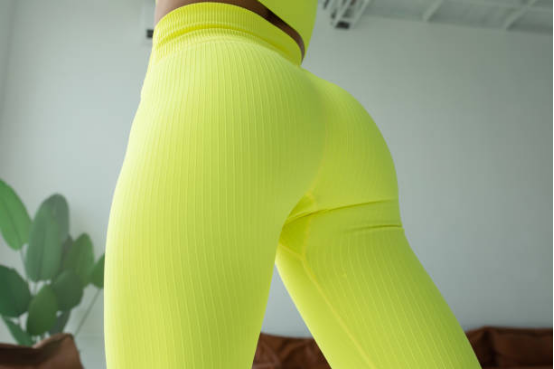
Beyond comfort, seamless welding technology also lends the yoga pants a more modern look. The absence of seams creates smoother lines, allowing designers to create a sense of visual fluidity through the cut and material combination. For example, the subtle distribution of heat-pressed layers between glossy and matte areas creates a “body shadow” effect, which appears exceptionally three-dimensional under lighting.
Crucially, sustainability is key. Welding technology effectively reduces fabric waste and thread usage. According to estimates by the Fashion Tech Alliance, each pair of seamless yoga pants produced results in approximately 15% less scrap than traditional sewing methods. For brands striving for carbon neutrality, this is undoubtedly a highly valuable innovation.
At the same time, seamless welding reduces the thickness caused by multiple overlapping seams, making the entire pair of pants lighter and more breathable. For those who wear them for long periods of time, such as those who sit in the office for a long time or travel long distances, this design significantly reduces the pressure on the waist and thigh roots.
The real shift in user experience: when technology replaces perceived “presence”
Interestingly, the greatest appeal of seamless yoga pants lies not in their appearance but in their “no-feeling.” People who wear them often describe it as “like a second skin,” a feeling that stems from the body’s low-interference nervous system.
Traditional stitching, due to friction and pressure, can be perceived by the body as a “foreign object.” Seamless welding reduces this distraction, allowing users to focus more on breathing and posture during exercise. Research shows that reduced pressure in clothing directly impacts perceived comfort and exercise duration and psychological relaxation. In other words, a good pair of yoga pants isn’t just about aesthetics or functionality; it helps people connect to their core.
For this reason, seamless welding technology is gradually being extended to cycling pants, compression pants, and even medical rehabilitation clothing. In the future, “seamless” will no longer just be a synonym for comfort but a philosophy of health.

From trend to future: seamless welding will define the dressing logic of the next decade
As more and more brands join the “seamless race,” the boundaries of yoga pants craftsmanship continue to expand. In the coming years, we will see more intelligent welding integration, such as the combination of nanoscale hot-melt layers and biodegradable adhesives, making products more environmentally friendly while maintaining high performance.
In the future, yoga pants may no longer be simply athletic gear worn on the body but rather intelligent devices that integrate body feedback, temperature regulation, and even physiological monitoring. The significance of seamless welding may extend beyond simply concealing seams, providing a more “invisible” infrastructure for the next generation of smart apparel.
Maybe one day, when we talk about yoga pants again, we will no longer be discussing the comfort of a pair of pants but a piece of technology that can “breathe” with the body.